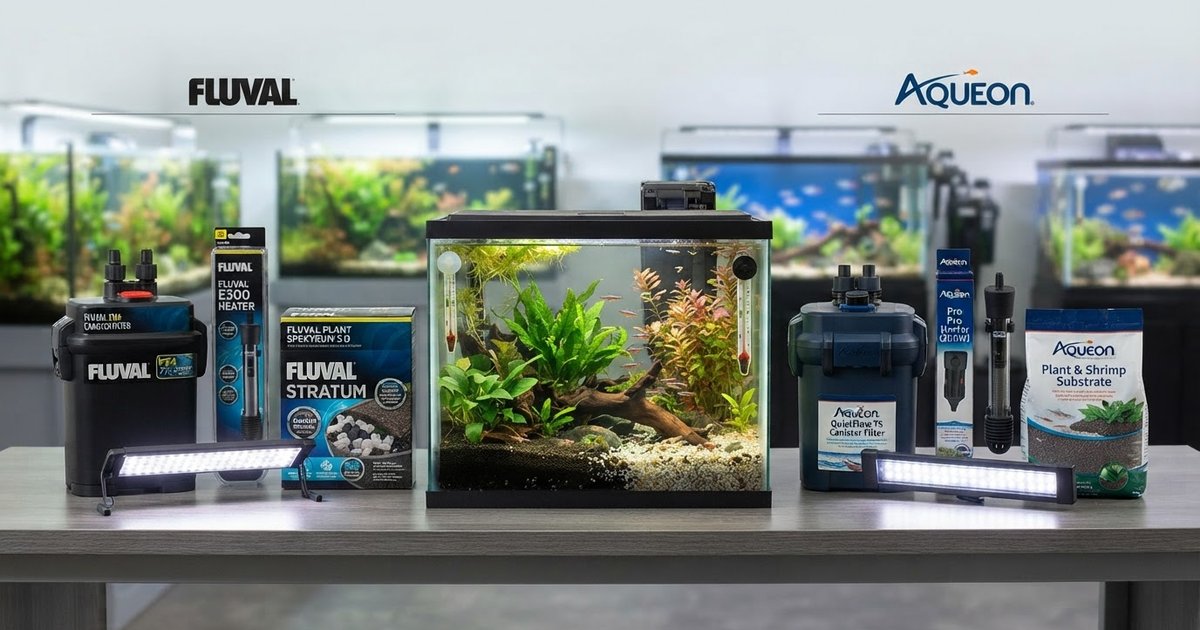
Walk into any aquarium store and you’ll find shelves stocked with two names: Fluval and Aqueon. The Fluval vs Aqueon debate splits hobbyists because these brands occupy opposite corners of the market. Fluval engineers premium equipment with features like digital temperature displays and multi-stage filtration, while Aqueon builds straightforward, budget-friendly gear that gets the job done without frills.
This breakdown compares filters, heaters, tanks, and substrate across both brands so you can match equipment to your actual needs. A 20-gallon beginner tank demands different priorities than a 75-gallon planted setup, and spending $150 on a Fluval canister filter makes no sense if a $40 Aqueon hang-on-back handles your bioload perfectly fine. The fluval vs aqueon canister filter question matters most for larger tanks, while the fluval stratum vs aqueon debate centers on planted versus non-planted systems.
Most experienced aquarists own equipment from both brands because neither wins every category. Fluval dominates planted tank substrate and high-capacity filtration, but Aqueon heaters often outlast their pricier competitors, and Aqueon starter kits cost half what Fluval charges. Choosing the wrong heater risks cooking your fish at 90 degrees, and picking an underpowered filter leaves you scraping algae weekly, so understanding where each brand excels prevents expensive do-overs.
Fluval vs Aqueon Canister Filters: Performance and Value
Canister filters separate the serious aquarists from the hang-on-back crowd, and here the performance gap widens. The Fluval 07 series (207, 307, 407) pushes higher GPH ratings through 5-7 media baskets, giving you room for ceramic rings, bio-media, carbon, and polishing pads in true multi-stage filtration. Aqueon’s Quietflow canister line (models 200-400) uses 3-4 baskets, which handles most community tanks but limits customization for planted or heavily stocked setups.
Price tells half the story. The Aqueon Quietflow 300 retails around $120-140, while the comparable Fluval 307 runs $160-180. That $40 gap shrinks when you account for what’s in the box. Fluval includes a self-priming pump that eliminates the siphon-starting headache and throws in more filter media, so you’re not buying bags of ceramic rings your first week.
Maintenance schedules favor Fluval’s larger media capacity. Their canisters run 4-6 months between deep cleanings because more media volume means slower clogging. Aqueon Quietflow owners typically crack open their canisters every 2-3 months. If you travel frequently or just hate maintenance, that difference matters. Noise levels flip the advantage back: Aqueon Quietflow genuinely earns its name at 35-40 dB, while Fluval 07 units hum at 40-45 dB. The Fluval moves more water, but you’ll hear it during late-night water changes.
Hang-On-Back Filters: Fluval AquaClear vs Aqueon QuietFlow
Hang-on-back filters tell a different story. The Fluval AquaClear line lets you stack your own media (foam, carbon, BioMax ceramic rings) in whatever order suits your tank, while Aqueon QuietFlow locks you into proprietary cartridges that cost $8 to $12 each and need replacing monthly. That monthly expense adds up to $96 to $144 annually, compared to AquaClear media that lasts 6 to 12 months and costs $15 to $25 to replace all three stages at once.
Flow control separates these filters further. AquaClear models include a dial that adjusts flow from 20% to 100%, which matters enormously if you keep bettas or raise fry in low-current environments. Aqueon QuietFlow units run at a single fixed speed, so you either accept the flow rate or buy a different model. Both brands share the same parent company (Hagen) and use identical pump motors internally, so reliability and lifespan track nearly the same. The real choice comes down to whether you value customization and lower running costs (AquaClear) or prefer the simplicity of drop-in cartridges (QuietFlow).
Fluval vs Aqueon Heaters: Accuracy and Durability
Heaters show a clearer winner depending on your priorities. Fluval E-Series heaters mount an LCD display on the control head that shows real-time temperature within ±0.5°F, letting you spot swings before they stress fish. Aqueon Pro heaters use a dial control and maintain ±1°F accuracy, which works fine for most community tanks but falls short for discus, crystal shrimp, or marine reef setups where half a degree matters. The Fluval E-Series is fully submersible, so you can position it horizontally near the substrate or tuck it behind hardscape. Aqueon Pro requires the control dial to stay above the waterline, limiting placement options in shallow tanks or rimless setups.
Durability splits in an unexpected direction. Aqueon Pro heaters carry a lifetime warranty and use shatterproof construction that survives drops and bumps during water changes. Fluval E-Series heaters come with a 3-year warranty and glass construction, which means they can crack if you knock them against rock or pull them out while still hot. In five years of use, I’ve replaced one cracked Fluval E200 but never an Aqueon Pro.
Price tips the scale further. A 100W Aqueon Pro costs $25 to $30, while the comparable Fluval E100 runs $45 to $55. Aqueon wins on value for standard community tanks, but Fluval’s precision justifies the premium if you’re keeping species that need tight temperature control. For hobbyists asking are Aqueon aquariums good or are Fluval aquariums good, the heater choice often mirrors the tank choice: Aqueon delivers reliability at a budget price, Fluval adds features for advanced keepers willing to pay more.
Aquarium Tank Quality: Build and Features
Tank selection splits along the same price-versus-convenience line. Fluval’s Flex, Spec, and Evo lines bundle built-in filtration, LED lighting, and curved glass into all-in-one kits starting at $120 for 5-gallon models. You unbox it, add substrate and water, and you’re running. Aqueon sells standard rectangular tanks with straight glass and silicone seams as tank-only units, starting at $25 for a 10-gallon. That bare tank needs a separate filter, heater, light, and lid before you can keep fish, but you control every component choice.
Glass thickness differs slightly but both meet safety standards. Fluval tanks use 5-6mm glass on their 10-20 gallon models, while Aqueon uses 4-5mm on equivalent sizes. The thicker glass in Fluval kits adds rigidity to accommodate the integrated filtration chambers molded into the back or side of the tank. Aqueon’s thinner glass works fine for open-top designs where the rim bears most structural load.
Both brands back tanks with 1-year warranties against leaks and manufacturing defects. Fluval’s all-in-one kits cost $120-200 depending on size, but they eliminate the guesswork for beginners who don’t yet know which filter pairs with which tank or how many watts of heating a 15-gallon needs. Aqueon’s $25-60 tank-only pricing appeals to hobbyists who already own equipment or want to mix brands, choosing an AquaClear filter with an Aqueon tank and a Fluval heater if that combination fits their setup.
Fluval Stratum vs Aqueon Plant and Shrimp Substrate
Substrate choice matters more than most beginners realize, and Fluval Stratum versus Aqueon Plant and Shrimp Substrate illustrates the divide. Fluval Stratum drops pH to 6.0-6.5 and softens water through volcanic soil buffering, making it the default choice for crystal shrimp, Caridina species, and acid-loving plants like Cryptocoryne. Aqueon’s clay-based substrate holds pH at neutral 7.0, which suits Neocaridina shrimp, livebearers, and community tanks where you don’t want water chemistry swings.
Nutrient longevity separates them further. Fluval Stratum delivers volcanic soil minerals that feed root systems for 12 to 18 months before exhausting, giving plants like Amazon swords and Vallisneria strong anchoring and nutrient uptake. Aqueon’s clay pellets carry nutrients for 6 to 12 months, a shorter window that works fine for fast-growing stems or tanks where you dose liquid fertilizers anyway.
Handling and breakdown tell different stories. Fluval Stratum clouds the water if you pour it in carelessly (rinse gently, don’t agitate), and the granules crumble into finer particles after 18 to 24 months, compacting the substrate layer. Aqueon pellets stay intact longer and produce less dust, but you lose the pH buffering that keeps sensitive shrimp alive through water changes.
Cost per gallon runs $18 to $22 for a 4.4-pound bag of Fluval Stratum, covering 5 gallons at a 2-inch depth. Aqueon’s 5-pound bag costs $12 to $15 for the same coverage, undercutting Fluval by about 40 percent if you’re setting up a neutral-pH tank and don’t need the buffering capacity.
LED Lighting: Fluval AquaSky vs Aqueon OptiBright
Lighting budgets swing just as wide. The Fluval AquaSky brings Bluetooth app control, 24-hour programmable cycles, and spectrum adjustment from 6500K to 25000K, letting you dial in dawn-to-dusk transitions or boost reds for plant coloration. Aqueon OptiBright sticks with manual on/off switches and two fixed modes: daylight white and blue moonlight. You tap a button, the lights turn on. No timers, no gradual ramps, no spectrum tweaks.
PAR output separates low-tech fish tanks from planted setups. Fluval AquaSky delivers 50 to 80 PAR at 12 inches, enough for medium-light carpeting plants like dwarf hairgrass or Cryptocoryne species. Aqueon OptiBright puts out 30 to 50 PAR at the same depth, which keeps anubias and java fern alive but won’t push demanding stems or foreground carpets. If you’re running CO2 injection or chasing tight plant growth, you need the extra photons Fluval provides.
A 20-inch Fluval AquaSky costs $90 to $110, while the same-length Aqueon OptiBright runs $40 to $55. You’re paying double for the app control and programmable sunrise simulation. That premium makes sense for planted tanks where light timing affects algae and plant health, but it’s wasted money on a fish-only community tank with plastic decor. Pick Fluval if you’re dosing fertilizers and trimming stems weekly. Grab Aqueon if you just want to see your fish without fiddling with schedules.
Frequently Asked Questions
Is Fluval better than Aqueon? No, but it costs more for features serious aquarists actually use. Fluval builds equipment like the FX6 canister filter ($350) and E-Series heaters ($45 to $65) with digital controls, tighter tolerances, and multi-stage media capacity that matter in planted tanks, reef systems, or breeding setups. Aqueon targets beginners with simpler gear like QuietFlow filters ($25 to $40) and standard glass tanks ($30 for a 10-gallon) that get fish wet without the learning curve.
Which brand lasts longer? Fluval, but the gap is smaller than the price difference suggests. Fluval canister impellers and O-rings typically run 4 to 6 years before needing replacement parts, while Aqueon QuietFlow motors last 3 to 5 years in most setups. Both brands honor one to three year warranties depending on the product line, so catastrophic failures get covered either way.
Can you mix Fluval and Aqueon products? Yes, and most hobbyists do exactly that. You might run a Fluval 407 canister on a standard Aqueon 75-gallon breeder tank, or pair Aqueon OptiBright lighting with Fluval Stratum substrate in a budget planted setup. The brands use standard tubing sizes (5/8 inch and 3/4 inch) and universal heater clips, so components swap freely.
Which brand offers better customer support? Fluval responds faster but Aqueon replaces defective units with less hassle. Fluval’s online ticket system typically answers technical questions within 24 hours, while Aqueon phone support runs during business hours only. Aqueon retailers handle most warranty swaps in-store, saving you return shipping time that Fluval requires for direct replacements.
Final Verdict: Choosing Between Fluval and Aqueon
Pick Fluval if you’re running planted tanks, keeping sensitive species requiring precise parameters, or want all-in-one solutions. The 40 to 80 percent premium you pay upfront buys digital temperature controls accurate to half a degree, multi-stage filtration with six months between media swaps, and app-controlled lighting that simulates natural photoperiods. Discus breeders, crystal shrimp keepers, and aquascapers building high-tech CO2 setups consistently choose Fluval because the tighter tolerances prevent parameter swings that cost more in livestock losses than you save on equipment.
Choose Aqueon for budget-conscious setups, fish-only tanks, or when you prefer modular equipment you can upgrade piece by piece. A 20-gallon Aqueon tank costs $30 versus $120 for a comparable Fluval Flex kit, and that price gap lets you allocate funds toward better livestock or more plants. The lifetime heater warranty covers replacements without receipts or time limits, and switching from proprietary QuietFlow cartridges to reusable sponge and ceramic media drops your annual filter costs from $96 to under $15. Community tank owners keeping hardy species like tetras, barbs, and livebearers get everything they need without paying for precision they won’t use.
Many experienced aquarists mix brands instead of pledging loyalty to one logo. Aqueon Pro heaters deliver the best reliability-to-cost ratio at $25 with lifetime coverage, while Fluval AquaClear filters give you media flexibility that proprietary cartridge systems can’t match. Substrate choice depends entirely on water chemistry goals, not brand preference. A typical mixed setup pairs an Aqueon 40-gallon breeder ($50), AquaClear 70 filter ($60), and Aqueon Pro 200-watt heater ($25) with whatever substrate buffers or stabilizes the parameters your specific fish and plants require.
Frequently Asked Questions
Is Aqueon or Fluval better?
Fluval excels in filtration technology and premium equipment while Aqueon dominates in affordable starter kits and basic tanks. Fluval’s canister filters like the FX series push 400+ GPH through multi-stage media baskets, but you’ll pay $250-350 versus $120-180 for comparable Aqueon models. Aqueon’s all-in-one kits bundle tank, filter, heater, and lighting for $50-80, while Fluval’s Spec and Flex kits start at $120 for similar sizes but include Bluetooth-controlled LEDs and integrated filtration chambers.
Is Fluval a good aquarium brand?
Fluval targets experienced aquarists with canister filters that run 4-6 months between cleanings and planted tank substrates that buffer pH to 6.0-6.5 for crystal shrimp. Their Spec and Flex nano tanks (5-16 gallons) pack built-in filtration and curved glass into compact footprints that fit desks and countertops. The brand’s products cost 40-80 percent more than budget alternatives, but the FX6 canister ($350) moves 563 GPH through seven media baskets, while the E-Series heaters hold temperature within 0.5°F instead of the 1-2°F swings cheaper models allow.
What is the best brand for aquariums?
Fluval leads in canister filtration with the FX series (400+ GPH, $250-350), Aqueon in starter kits ($50-80 with tank, filter, heater, and light), and brands like Marineland compete with HOB filters while Eheim builds German-engineered canisters for $300-500. A planted tank keeper might run a Fluval 407 canister ($180) with Aqueon Pro heaters ($25 with lifetime warranty) on a standard Aqueon 40-gallon breeder ($50), mixing brands to get the best component for each job rather than paying premium prices across the board.
Are Aqueon tanks good quality?
Aqueon tanks use 4-5mm glass on 10-20 gallon models and silicone seals that hold for 5-10 years in typical use. Their standard rectangular tanks come from the same manufacturing facilities as several other budget brands, making a $30 Aqueon 10-gallon functionally identical to competitors at the same price point. The rimmed design adds structural support for larger sizes like 55 and 75 gallons (which hold 460-630 pounds when filled), but you lose the frameless aesthetic that rimless tanks provide for aquascaping setups where the glass edges stay visible.
Leave a Reply